Buddy Punching: What It Is and How Businesses Can Prevent It
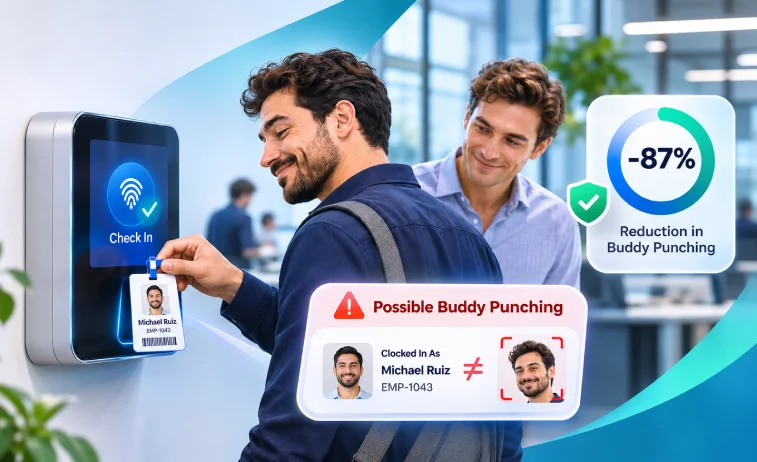
An employee arrives 20 minutes late, but their timesheet shows they clocked in on time. How? A coworker recorded their attendance before they arrived.
This practice is known as buddy punching. It might seem like a small favor between colleagues, but it creates a bigger problem for employers: paying for hours that employees haven't actually worked.
Buddy punching can lead to inaccurate timesheets, unnecessary payroll expenses, and unreliable attendance records. For businesses managing multiple employees, shifts, or departments, these discrepancies can become difficult to identify without proper oversight.
Understanding how buddy punching happens, recognizing its warning signs, and using reliable timekeeping practices can help businesses protect payroll accuracy and improve workforce accountability.

What Is Buddy Punching?
Buddy punching is a form of employee time theft in which one employee clocks in or out on behalf of another employee who isn't physically present or hasn't started or finished their shift.
It usually happens when businesses rely on shared time clocks, employee PINs, access cards, or other timekeeping methods that don't adequately verify who is recording attendance.
For example: An employee is scheduled to start work at 8:00 AM but arrives at 8:25 AM. Instead of recording the actual arrival time, a coworker clocks them in at 8:00 AM.
The attendance system records a successful punch, even though the employee wasn't there.
The employee receives credit for 25 minutes they didn't work, and the business pays for time that wasn't actually spent on the job.
Buddy punching can happen during clock-ins and clock-outs, making it difficult to identify when managers rely entirely on recorded attendance.

Common Examples of Buddy Punching in the Workplace
Buddy punching doesn't always involve complicated timekeeping manipulation. It can happen through everyday interactions between coworkers.
Here are some common examples:
1. Clocking in for a late employee
An employee asks a coworker to clock them in before they arrive, allowing them to avoid recording a late start.
2. Clocking out for someone leaving early
An employee leaves before their scheduled shift ends, but a coworker records their clock-out at the correct time.
3. Covering for an absent employee
An employee doesn't report to work but asks a colleague to record their attendance to make it appear that they completed their shift.
4. Manipulating overtime records
Coworkers coordinate their clock-in or clock-out times to make attendance records show more working hours than they actually completed.
5. Repeated attendance favors
Some employees regularly cover for one another, turning an occasional favor into a recurring timekeeping problem.
Regardless of how it happens, the result is the same: attendance records no longer accurately represent the hours employees worked.
Why Do Employees Engage in Buddy Punching?
Buddy punching isn't always driven by financial motives. In some workplaces, employees may treat it as a harmless favor without considering its impact on the business.
Several factors can encourage this behavior.
Workplace friendships: Employees may cover for coworkers to maintain good relationships or return favors.
Avoiding disciplinary action: Some employees ask colleagues to hide late arrivals or early departures.
Weak timekeeping systems: Shared PINs, access cards, or poorly controlled time clocks make it easier to record attendance for someone else.
Lack of accountability: Employees may assume that managers rarely review attendance records closely.
Workplace culture: When employees see coworkers doing it without consequences, they may start treating it as acceptable behavior.
A 2026 OnTheClock survey of 831 U.S. hourly workers found that 25% had engaged in buddy punching or had someone do it for them during the previous 12 months. The survey also found that 71% knew their employer had a policy against it.
This suggests that written policies alone may not be enough. Businesses also need reliable timekeeping processes and consistent oversight.
How Does Buddy Punching Affect Businesses?
A few minutes of inaccurate attendance might not seem significant. However, repeated incidents across multiple employees can affect payroll, scheduling, and workforce planning.
Here are the main consequences.
Increased payroll expenses
Businesses pay employees based on recorded working hours. When employees receive credit for time they haven't worked, payroll expenses increase without any corresponding work output.
Inaccurate attendance records
Buddy punching makes it difficult to determine when employees actually arrive, leave, or complete their shifts. Managers may end up making decisions based on unreliable records.
Unfair employee accountability
Employees who follow attendance policies may feel disadvantaged when coworkers receive credit for hours they haven't worked. This can undermine trust and create frustration across teams.
Unreliable overtime calculations
When clock-in and clock-out records are manipulated, overtime calculations can become inaccurate. This makes it harder to understand actual labor costs.
Poor workforce planning
Managers rely on attendance information to schedule employees, allocate workloads, and maintain adequate staffing. Inaccurate records make these decisions less reliable.
The bigger issue isn't just the extra minutes recorded. It's the loss of confidence in the information businesses use to manage their workforce.
How to Detect Buddy Punching in Your Workplace
Buddy punching can be difficult to identify because the timekeeping system may show a completely valid clock-in or clock-out.
However, managers can look for unusual patterns and discrepancies that deserve further investigation.
1. Review unusual attendance patterns
Look for repeated clock-ins or clock-outs that don't align with an employee's normal attendance behavior. Frequent discrepancies around shift start and end times may warrant closer review.
2. Compare scheduled shifts with recorded hours
Compare employee schedules with their actual attendance records. Repeated differences between scheduled and recorded hours can highlight potential problems.
3. Investigate recurring attendance discrepancies
Pay attention to employees who repeatedly have similar attendance adjustments or unusual punch patterns. Review the circumstances instead of assuming every discrepancy is misconduct.
4. Review activity and work-hour records
Compare attendance information with available work activity records. For example, an employee may have a recorded start time that doesn't align with their recorded computer activity.
This can provide useful context, particularly in office-based and computer-dependent roles. However, computer activity alone cannot prove whether someone was physically present or whether a coworker made the punch.
5. Audit manual time adjustments
Review changes made to timesheets, including who made the adjustment, when it happened, and whether a valid explanation was provided.
How StaffViz Helps Managers Review Attendance and Activity
When attendance records and employee activity are managed separately, managers may struggle to understand how recorded working hours translate into actual work.
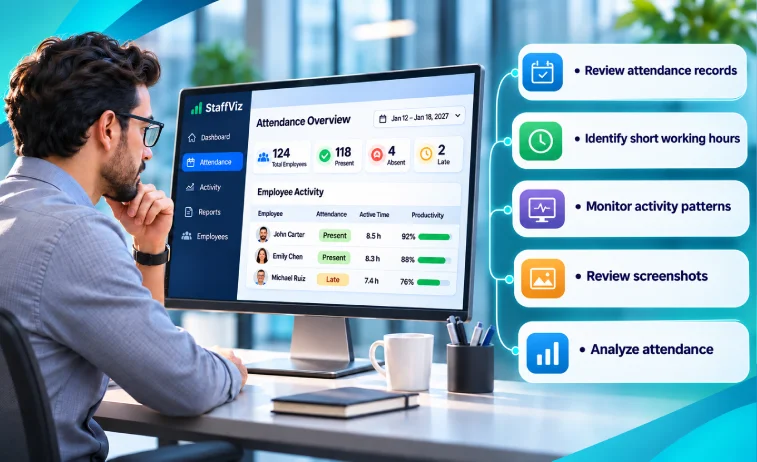
StaffViz brings attendance monitoring, time tracking, and employee activity reporting into one workforce management platform.
Managers can use StaffViz to:
Review attendance records: Monitor clock-in, clock-out, shift schedules, and recorded working hours.
Identify short working hours: Review employees who haven't completed their required hours.
Monitor activity patterns: Understand active, idle, inactive, and break periods during recorded working hours.
Review screenshots: Examine available screen capture reports to understand computer-based work activity.
Analyze attendance: Generate reports by employee, department, and shift to review workforce attendance patterns.
These insights help managers investigate discrepancies and make better-informed workforce decisions.
StaffViz doesn't independently verify the identity of the person making a clock-in or prevent a coworker from punching in for someone else. Instead, it helps businesses gain better visibility into attendance and recorded work activity.
Explore StaffViz
7 Ways to Prevent Buddy Punching
Detecting buddy punching is important, but businesses should also make it harder for employees to manipulate attendance records in the first place.
Here are seven practical ways to reduce the risk.
1. Introduce biometric time clocks
Fingerprint and facial recognition systems verify an employee's identity before accepting a punch. Unlike shared PINs or access cards, biometric verification makes it harder for another employee to clock in on someone's behalf.
However, businesses should review applicable biometric privacy laws, consent requirements, and data retention rules before implementing these systems.
2. Use photo-based clock-in verification
Some attendance systems capture an employee's photograph when they clock in or out. Managers can review these images to check whether the person recording attendance matches the assigned employee.
3. Implement GPS and geofencing
Location-based attendance restrictions can limit clock-ins to approved work locations. This is particularly useful for businesses with field employees, multiple work sites, or distributed teams.
GPS verifies the device's location, not the identity of the person using it. It should therefore be combined with other verification methods.
4. Establish clear attendance policies
Create a written policy explaining what buddy punching is, why it is prohibited, and what consequences employees may face.
Make sure employees understand the policy and that managers apply it consistently.
5. Conduct regular timesheet audits
Review attendance records before payroll processing. Look for repeated discrepancies, unusual time adjustments, and inconsistencies between scheduled and recorded working hours.
6. Restrict unauthorized timesheet changes
Limit who can edit attendance records and maintain a clear record of adjustments. Employees should provide explanations for missed punches or corrections rather than making undocumented changes.
7. Use employee time tracking software
Time tracking software helps businesses maintain organized attendance records, monitor working hours, and review employee activity.
For computer-based teams, platforms such as StaffViz can connect attendance information with activity reports, screenshots, and work-hour analytics.
This gives managers additional context when reviewing attendance discrepancies instead of relying exclusively on clock-in and clock-out records.
How StaffViz Helps Businesses Improve Attendance Accountability
Preventing buddy punching requires more than knowing when an employee clocked in. Businesses also need a reliable way to understand attendance patterns, working hours, and employee activity.
StaffViz combines attendance monitoring, employee time tracking, and workforce analytics to give managers a clearer picture of how their teams work.
With StaffViz, businesses can:
Connect attendance with shift schedules
Compare recorded attendance against assigned shifts to understand schedule adherence and identify employees who haven't completed their required hours.
Monitor working hours and breaks
Review total working hours, break durations, and employee status to understand how time is distributed throughout the workday.
Review employee activity
Use active and idle time reports to gain insight into computer-based work activity during recorded working hours.
Investigate attendance discrepancies
Compare attendance information with available activity reports and screenshots to identify inconsistencies that require further review.
Make better workforce decisions
Use attendance reports and analytics across employees, departments, and shifts to improve workforce visibility and planning.
StaffViz doesn't replace identity verification tools such as biometric time clocks. It complements attendance controls by helping managers understand recorded working hours and employee activity.
Instead of relying on timesheets alone, businesses can use StaffViz to make workforce decisions based on a broader view of attendance and work activity.
Frequently Asked Questions
1. What is an example of buddy punching?
When an employee asks a coworker to clock them in before they arrive at work, it is considered buddy punching.
2. Is buddy punching considered time theft?
Yes. Buddy punching can be considered time theft because employees receive credit for working hours they haven't actually completed. The legal and disciplinary implications depend on applicable laws and company policies.
3. How can employers detect buddy punching?
Employers can review unusual attendance patterns, compare scheduled shifts with recorded hours, audit time adjustments, and use identity verification systems.
4. Can time tracking software prevent buddy punching?
Not all time tracking software prevents buddy punching. Identity verification features such as biometrics and photo verification provide more direct protection, while attendance and activity reporting help managers investigate discrepancies.
5. Does GPS tracking prevent buddy punching?
GPS tracking can restrict clock-ins to approved locations, but it doesn't verify who is using the device. Additional identity verification may be needed.
6. Can employee monitoring software detect buddy punching?
Employee monitoring software can help managers identify inconsistencies between recorded working hours and available activity data. However, computer activity alone cannot conclusively establish who made an attendance punch.
7. What should an employer do if an employee buddy punches?
Review the attendance records, investigate the circumstances, document the findings, and follow the company's established disciplinary procedures consistently.
8. Can buddy punching lead to termination?
It can lead to disciplinary action, including termination, depending on the seriousness of the incident, company policy, employment agreements, and applicable labor laws.
9. Can StaffViz help businesses identify attendance discrepancies?
Yes. StaffViz provides attendance records, working-hour reports, and employee activity insights that help managers review discrepancies and investigate unusual patterns.
10. Does StaffViz prevent buddy punching?
StaffViz is not a biometric identity-verification system. However, its attendance monitoring and employee activity reporting help managers gain better visibility into recorded working hours.
11. How does StaffViz help managers monitor employee working hours?
StaffViz tracks attendance, active and idle time, breaks, and employee activity. Managers can use its reports and screenshots to better understand how employees spend their recorded working hours.
Effectively Manage Remote and Hybrid Teams with StaffViz
Enhance team efficiency and collaboration with StaffViz, the ultimate tool for managing remote and hybrid teams.
Talk To Us

Table of Content
- What Is Buddy Punching?
- Common Examples of Buddy Punching in the Workplace
- Why Do Employees Engage in Buddy Punching?
- How Does Buddy Punching Affect Businesses?
- How to Detect Buddy Punching in Your Workplace
- How StaffViz Helps Managers Review Attendance and Activity
- 7 Ways to Prevent Buddy Punching
- How StaffViz Helps Businesses Improve Attendance Accountability
- Frequently Asked Questions