Microsoft's Employee Buyouts: Who Will Do the Work When Employees Leave?
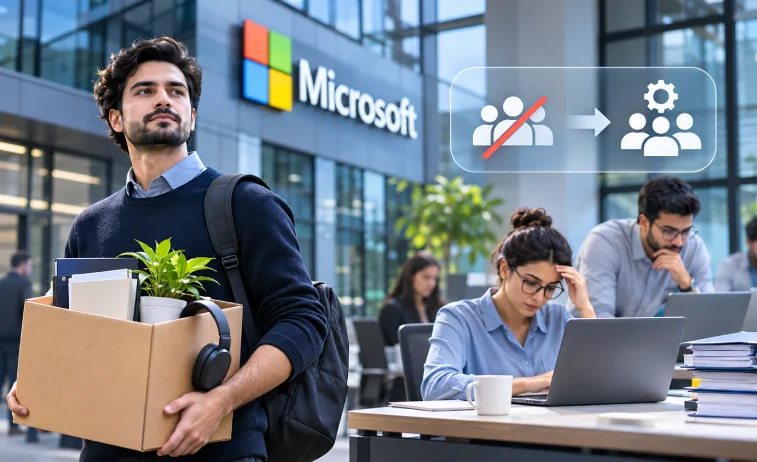
Microsoft's decision to offer voluntary exits to approximately 60,000 employees has raised an important question about the future of work: if employees leave, who takes responsibility for their projects, customers, and daily operations?
Announced on October 26, 2026, Microsoft's Voluntary Exit Offer (VEO) gives eligible employees in participating teams across the United States, Canada, the United Kingdom, and India the option to leave the company with financial support and career planning resources. The eligible group represents roughly 27% of Microsoft's 223,000-person global workforce, but it does not mean that all 60,000 employees will leave.
The announcement highlights a challenge that extends beyond Microsoft. Businesses regularly adjust their workforce to manage costs, adopt new technology, and respond to changing priorities. But reducing headcount does not automatically reduce the amount of work an organization needs to complete.
When employees leave, their responsibilities still exist. Companies must decide how to redistribute that work, preserve institutional knowledge, and maintain productivity without placing unsustainable pressure on the remaining workforce.
Understanding how businesses manage this transition also raises another question: do managers have enough visibility into how their existing teams spend their working hours?
What Is an Employee Buyout?
An employee buyout is a voluntary arrangement in which a company offers eligible employees financial compensation and other benefits in exchange for agreeing to leave their jobs.
These arrangements are also known as voluntary separation programs, voluntary exit offers, or voluntary separation packages. Employees can review the terms and decide whether accepting the offer makes sense for them.
Companies may introduce employee buyouts to reduce payroll expenses, restructure departments, adjust workforce capacity, or redirect resources toward changing business priorities.
How Does a Voluntary Employee Buyout Work?
Although the terms vary between organizations, a typical voluntary employee buyout follows a straightforward process:
- Eligibility: The company identifies which employees, departments, or locations can participate.
- Offer: Eligible employees receive details about the financial package, benefits, and departure arrangements.
- Decision: Employees review the offer and decide whether to accept it within the specified period.
- Separation: Employees who accept leave according to the agreed terms and receive the applicable compensation and support.
The financial package may include severance pay, continued benefits, career transition assistance, or other incentives, depending on the employer's policy and local employment laws.
Employee Buyouts vs. Layoffs: What's the Difference?
The main difference is who initiates the employment separation.
A buyout can give employees more control over their departure while helping companies adjust their workforce. However, it also creates operational considerations. Employees who leave may take valuable experience, customer knowledge, and project expertise with them.
Why Is Microsoft Offering Buyouts to 60,000 Employees?
Microsoft announced its Voluntary Exit Offer on October 26, 2026, through a communication from Amy Coleman, the company's Executive Vice President and Chief People Officer.
The offer is available to eligible employees at level 70 and below in participating organizations across the United States, Canada, the United Kingdom, and India. Not every Microsoft employee or department is included. Eligibility depends on the priorities, customer commitments, and workforce needs of individual business units.
Microsoft describes the initiative as a way to give employees considering opportunities outside the company a supported path to leave. It also gives participating organizations more flexibility to adapt their workforce.
The announcement follows Microsoft's earlier Voluntary Retirement Program in 2026. The company has also made separate workforce reductions during the year.
Is Microsoft's Buyout Program Related to AI Investment?
The timing has drawn attention because Microsoft is investing heavily in artificial intelligence infrastructure, including data centers and cloud computing capacity.
These investments require substantial capital, while the company must continue allocating resources across its existing products, services, and business operations.
External reporting has connected the buyout offer to Microsoft's broader cost management and AI investment priorities. However, Microsoft has not described the Voluntary Exit Offer as an AI-driven replacement program. Its official announcement emphasizes employee choice and the need for participating organizations to adapt to changing business needs.
It's also important to understand what the 60,000 figure represents. These employees are eligible to receive the offer; they are not all confirmed departures. The company has not publicly established that every eligible employee will accept.
The distinction matters because workforce planning depends on actual departures, not just the number of people who could leave.
If Employees Leave, Who Will Handle Their Responsibilities?
This is the operational question behind any voluntary buyout or workforce reduction.
When an employee leaves, the company does not automatically lose the need for their work. Projects still have deadlines, customers still expect support, and internal processes still need to function.
Consider a department where several employees manage customer accounts, prepare reports, coordinate projects, and resolve operational issues.
If some of those employees leave, management must determine who will take ownership of their responsibilities. Simply distributing the work among remaining employees may appear to be a quick solution, but it can create new problems.
Managers need to consider:
- Project ownership: Who will manage ongoing projects and outstanding deadlines?
- Knowledge transfer: How will specialized knowledge and undocumented processes be preserved?
- Customer continuity: Who will handle existing accounts, requests, and service commitments?
- Workload distribution: Can remaining employees absorb additional responsibilities without becoming overloaded?
- Operational performance: How will managers identify delays, errors, or declining work quality?
Without a structured transition, companies may save money on payroll while creating inefficiencies elsewhere.
The challenge is not simply to operate with fewer employees. It is to maintain the organization's ability to deliver work consistently.
5 Ways Companies Can Maintain Operations ith a Smaller Workforce
Reducing headcount requires more than removing positions from an organizational chart. Businesses need to reconsider how work gets completed, where resources are allocated, and which processes can be improved.
Here are five approaches companies can use to maintain operational continuity.
1. Redistribute Responsibilities Across Existing Teams
One option is to assign responsibilities previously handled by departing employees to existing team members.
However, this requires understanding current workloads before making changes. Managers should identify critical tasks, review employee capacity, and establish clear ownership for ongoing responsibilities.
For example, if an employee manages several customer accounts, the company might distribute those accounts among team members based on their experience and available capacity.
The goal is to maintain continuity without assigning more work than employees can reasonably handle.
2. Automate Repetitive Tasks With AI
Automation can help businesses reduce the time employees spend on repetitive administrative work.
Tasks such as routine reporting, data entry, document processing, and certain customer service activities may be suitable for automation, depending on their complexity.
AI tools can also assist employees with research, information retrieval, and workflow coordination.
However, automation is not a replacement for every employee or responsibility. Companies must evaluate which tasks can be automated reliably and where human judgment, technical expertise, or customer interaction remains necessary.
The most useful approach is to remove unnecessary manual work while allowing employees to focus on responsibilities that require their expertise.
3. Eliminate Inefficient Processes
Workforce restructuring can reveal processes that consume time without adding meaningful value.
Unnecessary approval layers, duplicated reporting, repeated data entry, and poorly defined handoffs can slow down operations.
Businesses should review these workflows and determine whether certain steps can be removed, simplified, or automated.
For instance, a company might consolidate reporting requirements across departments instead of asking multiple employees to prepare similar reports independently.
Improving processes can create additional capacity without immediately requiring new hires.
4. Reskill and Redeploy Existing Employees
Employees already understand their organization's products, customers, and internal processes. That experience can be valuable when business priorities change.
Instead of automatically hiring externally for every new requirement, companies can identify employees who have the potential to move into different roles.
Reskilling may include technical training, cross-functional learning, and developing new capabilities in areas such as AI, data analysis, or cloud technologies.
Redeployment also helps preserve institutional knowledge that might otherwise disappear when employees leave.
Microsoft has publicly stated that it will continue helping employees develop new skills and explore opportunities within the company where appropriate.
5. Use Workforce Analytics to Make Informed Staffing Decisions
Companies cannot make effective workforce decisions if they have little understanding of how their existing teams operate.
Tools like StaffViz become practical. StaffViz gives managers clear visibility into working hours, activity patterns, and productivity trends.
This information can help identify potential workload imbalances, changes in working patterns, and areas that may need additional support.
For example, if one team consistently works extended hours while another has available capacity, managers can investigate whether responsibilities should be redistributed.
The objective is not to assume that more computer activity means more output. It is to use workforce information alongside deadlines, quality standards, and actual business results to make better operational decisions.
The Hidden Risk of Asking Employees to Do More with Less
A smaller workforce does not automatically become a more productive workforce.
When companies redistribute responsibilities without reviewing employee capacity, the remaining team may face increasing pressure.
This can lead to several problems:
-
Employee burnout: Longer working hours and excessive responsibilities can affect employee well-being.
-
Declining work quality: Employees managing too many tasks may make more mistakes or overlook important details.
-
Missed deadlines: Workload imbalances can slow down projects and delay customer deliverables.
-
Knowledge gaps: Employees may struggle to perform tasks previously handled by experienced colleagues.
-
Higher employee turnover: Remaining employees may also consider leaving if workloads become unsustainable.
These problems can offset the financial benefits of workforce reductions.
Businesses need to understand whether their existing teams have the capacity to manage additional work before making staffing and operational decisions.
That requires more than checking attendance or asking managers for occasional updates. It requires consistent visibility into how work is progressing.
Why Workforce Visibility Matters During Restructuring
When teams change, managers need reliable information about how employees spend their working hours and how work patterns evolve.
Without that information, it becomes difficult to identify workload imbalances, understand operational capacity, or evaluate whether restructuring has improved efficiency.
Workforce visibility can help managers examine several areas:
These measurements should be interpreted in context.
For example, an employee who spends less time actively using a computer may still be completing valuable work through meetings, planning, research, or other activities. Activity data alone cannot establish an employee's actual contribution.
Managers should consider workforce analytics alongside role expectations, completed tasks, work quality, deadlines, and customer outcomes.
The purpose is to understand how the workforce operates, identify potential inefficiencies, and make better-informed decisions.
How StaffViz Helps Businesses Improve Workforce Visibility
Workforce restructuring is not limited to large technology companies. BPOs, call centers, professional services firms, and businesses managing remote or distributed teams also need to understand how their employees spend working hours.
StaffViz helps businesses gain visibility into employee working hours, activity patterns, attendance, and workforce productivity trends.
Instead of relying entirely on manual updates or assumptions, managers can use workforce information to better understand how their teams operate.
Track Employee Working Hours
StaffViz helps managers track employee working hours and understand time and attendance patterns.
This gives businesses a clearer picture of when employees are working and how working hours are distributed across their teams.
Monitor Employee Activity
Employee activity monitoring provides additional visibility into computer usage and work patterns during working hours.
Managers can use this information to investigate changes in activity and identify areas that may require attention.
Identify Workforce Productivity Trends
StaffViz provides workforce analytics and reporting to help managers understand employee activity and productivity patterns over time.
These insights can support conversations about workload distribution, process improvements, and operational efficiency.
Maintain Visibility Across Distributed Teams
Managing remote and distributed employees can make it harder to understand daily working patterns.
StaffViz gives managers a way to maintain workforce visibility across teams without relying solely on physical supervision.
The goal is not to monitor employees for the sake of monitoring. It is to give managers useful information to support better workforce planning and more informed operational decisions.
Workforce Restructuring Requires Better Decisions, Not Just Fewer Employees
Microsoft's voluntary exit offer highlights a challenge that businesses across industries must consider: how to adapt their workforce without disrupting the work that keeps the organization running.
Reducing headcount, introducing automation, and redistributing responsibilities can change how a business operates. But these decisions need to be supported by realistic workload planning and a clear understanding of existing workforce capacity.
Companies that focus only on payroll savings risk overlooking employee burnout, knowledge gaps, and operational inefficiencies.
Better workforce decisions start with understanding how teams actually work. With reliable workforce data, managers can identify patterns, review workloads, and make more informed decisions about staffing and operations.
Frequently Asked Questions
What is an employee buyout?
An employee buyout is a voluntary arrangement in which a company offers eligible employees financial compensation and benefits in exchange for agreeing to leave their jobs.
How does a voluntary employee buyout work?
The company offers eligible employees a separation package. Employees review the terms and decide whether to accept within the specified period. Those who accept leave according to the agreed arrangements.
What is the difference between employee buyouts and layoffs?
Employee buyouts are voluntary, meaning employees choose whether to accept the offer. Layoffs are initiated by employers when positions are eliminated or workforce reductions are made.
Why is Microsoft offering voluntary employee buyouts?
Microsoft says its Voluntary Exit Offer gives eligible employees a supported option to leave while allowing participating organizations to adapt their workforce to changing business needs.
How many Microsoft employees are eligible for the buyout?
Approximately 60,000 employees in participating teams across the United States, Canada, the United Kingdom, and India are eligible for Microsoft's 2026 Voluntary Exit Offer.
Will all 60,000 eligible Microsoft employees leave?
No. Eligibility does not mean employees must accept the offer. Participation is voluntary, and Microsoft has not confirmed that all eligible employees will leave.
How can businesses maintain productivity with fewer employees?
Businesses can maintain productivity by redistributing work carefully, automating suitable tasks, improving processes, reskilling employees, and monitoring workloads to prevent overcapacity and burnout.
What is workforce analytics software?
Workforce analytics software helps businesses understand employee working patterns through information such as working hours, attendance, activity, and productivity trends.
How does employee monitoring software help managers?
Employee monitoring software provides visibility into working hours and computer activity patterns. Managers can use this information alongside work quality and business outcomes to identify potential inefficiencies and workload concerns.
Can workforce analytics help businesses manage remote employees?
Yes. Workforce analytics can help managers understand working hours, attendance, and activity patterns across distributed teams, providing visibility without requiring employees to work from a shared office.
Effectively Manage Remote and Hybrid Teams with StaffViz
Enhance team efficiency and collaboration with StaffViz, the ultimate tool for managing remote and hybrid teams.
Talk To Us

Table of Content
- What Is an Employee Buyout?
- How Does a Voluntary Employee Buyout Work?
- Employee Buyouts vs. Layoffs: What's the Difference?
- Why Is Microsoft Offering Buyouts to 60,000 Employees?
- Is Microsoft's Buyout Program Related to AI Investment?
- If Employees Leave, Who Will Handle Their Responsibilities?
- 5 Ways Companies Can Maintain Operations ith a Smaller Workforce
- The Hidden Risk of Asking Employees to Do More with Less
- Why Workforce Visibility Matters During Restructuring
- How StaffViz Helps Businesses Improve Workforce Visibility
- Workforce Restructuring Requires Better Decisions, Not Just Fewer Employees
- Frequently Asked Questions